The right HD digital satellite TV receiver can make a big difference in how viewers enjoy television. It enables them to simultaneously record different channels so they do not have to worry about choosing between favourite programmes. Viewers can also stream content directly from the Internet to their receiver and enjoy it on their television. The top six HD satellite TV receivers all offer features that improve the way viewers enjoy television. Features differ from one receiver to the next, so consumers should determine which model best suits their viewing preferences.
TM-Nano 3T
Highlights
Full HD 1080p & True 3D
2x HD Satellite (DVB-S2) + 1x HD Terrestrial (DVB-T2) Tuners
1300MHz Broadcom Dual Core MIPS Processor
256MB Flash, 1GB DDR3 RAM
Linux Open Embedded
Internal 2.5” Hard Disk Drive Support, 3x USB Ports
Picture-In-Picture (2 HD PIP) + Transcoder
1x Smart Card Reader & 1x Common Interface (CI) Slot
Gigabit Ethernet Port
Running Broadcom's latest CPU, the 1.3Ghz lightning processor is 3x faster than the previous generation, making booting, channel changing and applications run a lot quicker!
With the TM-Nano 3T triple tuner, you can watch satellite channels in glorious High-Definition (HD), Full HD 1080p with Dolby Digital Plus to give you a superior audio experience. It’s also True 3D ready ensuring compatibility with future 3D formats.
It is an Open Embedded satellite receiver which has access to plenty of Third Party applications giving you a lot more features and plugins than a standard satellite receiver.
Want to know what's happening on another channel at the same time? Now you can. With HD Picture-In-Picture (PIP), you can view 2 HD channels at the same time!
The Gigabit Ethernet Port allows data to transfer up to 10x faster than standard Ethernet Ports allowing faster streaming, file transfers, downloading/uploading...and more!
Humax HDR-1000S
If there is just one defining feature of the Humax HDR-1000S,, it is the on-screen TV Guide that enables viewers to find other programmes without navigating away from what they are watching. The TV Guide also allows viewers to search for and watch programmes that have already aired. The HDR-1000S delivers over 150 channels, including free HD from BBC, ITV, and Channel 4. The twin tuner enables viewers to record one channel while watching another or simultaneously record from two channels. The 500 GB model records up to 125 hours in HD and 300 hours in standard definition, and the 1 TB model doubles that capacity. Viewers can also stream digital content from computers and USB drives through the HDR-1000S.
Vu Duo2
With dual tuners, dual display, and dual cores, the Vu Duo2doubles viewing pleasure. This HD digital satellite TV receiver provides two dual input/output tuners to receive signals from two television sources. The dual display shows a 1080p picture inside of a larger 1080p picture, enabling viewers to simultaneously enjoy two HD programmes. The Duo2 also offers built-in Wi-Fi, enabling users to stream HD Internet content and surf the Web directly through the receiver. People can also view content on mobile devices in other rooms.
Manhattan Plaza HD-S2
For viewing Freesat, the compact Manhattan Plaza HD-S2 has to be at the top of the list for HD digital satellite TV receiverss. Friendly for both the wall and the environment, the Plaza HD-S2 earned the recommendation of the Energy Saving Trust for using less than 1/2 watt of electricity in standby mode. This receiver broadcasts over 150 Freesat channels and upscales SD channels for enhanced viewing. The eight-day guide enables users to view the upcoming television schedule far in advance so they can catch their favourite programmes. Viewers can also add hundreds of additional non-Freesat channels if they want to expand their options.
TM-7102 HD Triple Tuner
Based on the highest rated satellite receiver ever! (92% by What Satellite magazine), the new HD range is even better!
Highlights
Full HD 1080p & 3D Ready
2x HD Satellite (DVB-S2) and 1x HD Terrestrial (DVB-T2) tuner
Record up to 3 HD channels and playback a recorded file at the same time
2.5”/3.5” Hard Disk Drive slot & 2x USB PVR ports
2x Smart Card Readers & 2x Common Interface (CI) slots
Ethernet Port (access YouTube, Weather, Maps…and more)
TM-8000 HD Combo
With the TM-8000 HD Combo, you can now watch Satellite and Terrestrial channels in one box! Furthermore, it has 2x Smart Card Readers & 2x Common Interface (CI) slots.
Highlights
1x HD Satellite (DVB-S2) and 1x Terrestrial tuner
Record up to 2 channels and playback a recorded file at the same time
Removeable 2.5" SATA HDD Bay
e-SATA & 2x USB PVR ports
2x Smart Card Readers & 2x Common Interface (CI) slots
Ethernet Port
Technomate TM-5402 HD M2
The Technomate TM-5402 HD M2 offers most features viewers want from their HD digital satellite TV receiver. It delivers full HD (1080p) for the best possible picture quality and Dolby Digital Plus for enhanced audio. The TM-5402 HD M2 is also 3D ready, so viewers with compatible televisions can enjoy 3D content. This receiver also upscales SD programmes to enhance picture quality, and it can simultaneously record up to three channels to an external USB hard disk drive ((sold separately). An Ethernet port enables content streaming from the Internet, and an RF modulator lets viewers watch content from the receiver on another television in a different room.
Sagemcom DSI86
The Sagemcom DSI86 is a low-profile and reasonably priced HD digital satellite TV receiver ideal for watching Freesat. It receives up to 140 television and 24 radio channels without a subscription. Through its HDMI port, the DSI86 upscales picture quality up to 1080i. It can connect to the Internet via an Ethernet cable,, so viewers can stream Web content and watch it on their television. The DSI86 also has the BBC iPlayer built in, enabling users to watch HD BBC content as long as they have a broadband connection with a speed of at least 1 Mbps.
Skybox F5s
The Skybox F5s features a dual-core processor, so viewers can enjoy delay-free operation. It supports personal video recording, enabling users to record programmes to a separate disk via a USB port. Digital audio output enhances the listening experience that goes along with HD viewing, and users can stream content from the Internet through the Ethernet port. The F5s also offers support in 13 languages.
One of our favorite DSLRs
in the past few years is the Nikon D7100, which was introduced way back
in February 2013. The D7200 isn't a radical upgrade by any means, yet
it still adds some important features, most notably a larger buffer,
improved autofocus performance in low light, 60p video, Wi-Fi with NFC,
and 15% better battery life.
The D7200 is Nikon's high-end APS-C camera, and is the only DX format
camera in the company's current lineup to support autofocus on screw
drive lenses. It finds itself in the same class as the Canon EOS 7D Mark II, Pentax K-3, and Sony SLT-A77 II DSLRs as well as the Fujifilm X-T1, Olympus OM-D E-M5 II, Samsung NX1, and Sony Alpha 7 II mirrorless cameras. In other words, it's a very crowded field.
Nikon D7200 key features
24.2MP CMOS sensor with no optical low-pass filter
Multi-CAM 3500DX II 51-point AF system, all sensitive to -3EV
2,016-pixel RGB metering sensor, used for 3D subject tracking in AF-C
ISO 100-25,600, with ISO 51,200 and 102,400 black and white modes
6 fps continuous shooting (7 fps in 1.3x crop mode) with increased buffer depth
1/8000 sec maximum shutter speed
3.2", 1.2M dot RGBW LCD display
1080/60p video (1.3x crop only) with clean output over HDMI and Flat Picture Control
Dual SD card slots
Wi-Fi with NFC
Magnesium alloy weather-sealed body
One of the most important features on the D7200 is its improved AF
system. Nikon has updated the D7200 to its Multi-CAM 3500DX II system,
which still offers 51 AF points (the central 15 of which are
cross-type), but now all of those points are sensitive to -3EV, while
the D7100's were limited to -2EV. The most obvious improvement in the D7200 compared to the D7100 will be noticed by anyone who shoots continuously. The buffer size on the D7100 was tiny
and filled up almost instantly, which not only affected burst shooting
but bracketing as well. You can now fire away with the D7200 for up to
18 14-bit lossless compressed, 27 12-bit compressed Raws, or 100+ JPEGs.
The maximum burst rate remains the same: 6 fps at full size and 7 fps
in 1.3x crop mode. The D7200 can now extend its ISO higher than on its predecessor, but
with a catch. Seeing how little color detail would be left at ISO 51,200
and 102,400, Nikon has chosen to make those two sensitivities black and
white only.
Two other new features of note are 60p video (with Flat Picture
Control, also available for stills) and Wi-Fi. While the addition of 60p
video is nice, it's only available in 1.3x crop mode. The D7200 also
has Wi-Fi with NFC, which Nikon has branded 'SnapBridge', which allows
for remote camera control and image transfer.
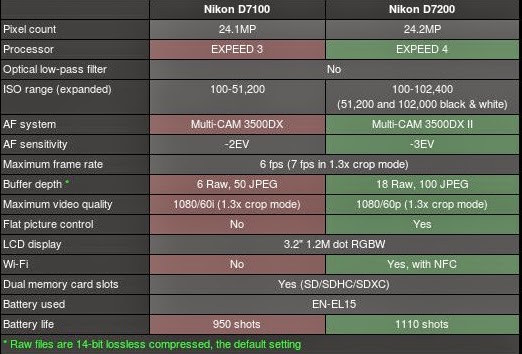
The first row of the table shows that there's a very small difference in
resolution between the two cameras. While Nikon wouldn't comment, we
wouldn't be surprised if the D7200 uses the same Sony-manufactured CMOS
sensor that is found on the D3300/D5300/D5500. If true, this will be
welcome news to those who experienced banding on the D7100, which used a
Toshiba sensor (that did, however, offer class-leading high ISO
performance). The Sony sensor has also proven to have excellent dynamic
range on other Nikon and Sony cameras that use it.
As mentioned above, the D7200's new autofocus system is a big deal. You can focus in conditions a full stop dimmer, and our tests
with the updated Multi-CAM 3500 II sensor in the D750 showed that it
continued to focus in significantly darker conditions than the Multi-CAM
3500 sensor in the D810 (a DX variant of which was used in the D7100).
What this means is that the camera will focus a whole lot better in low
light conditions, across the entire frame. In other words, its
non-central AF points will likely focus in dimmer conditions than any
other DSLR out there, save for Nikon's own D750.
Cross-type points remain limited to the central 15 though, and the
RGB metering sensor used for TTL metering is unchanged at a resolution
of 2,016 pixels. It's a shame that this number isn't higher. The
recently released Canon 7D Mark II itself offers a 150,000-pixel RGB+IR
metering sensor which, like Nikon's cameras with 91k-pixel sensors, has
enough resolution to even detect faces and focus on them during OVF
shooting. But Nikon's algorithms for 3D tracking just seem to
be better (Canon's iTR in the 7D Mark II is imprecise and laggy in
comparison, despite its higher resolution metering sensor), so we're
fans of Nikon's subject tracking algorithms in combination with their
higher resolution metering sensors.
If you want to control your camera without laying a hand on it, then
you'll appreciate the D7200's built-in Wi-Fi. Naturally, photos can be
transferred and shared, which is extra-easy if you have a NFC-compatible
smartphone.
Lastly, there's battery life. Perhaps its due to the more efficient
EXPEED 4 processor, but whatever Nikon has done, it's managed to squeeze
another 160 shots per charge out of the D7200 compared to the D7100.
Pricing and Availability
The D7200 will be available in two kits when it ships in early April.
For the body only it will be priced at $1199.95, and if you throw in
the 18-140mm f/3.5-5.6 ED VR lens the price rises to $1699.95.
If you're new to digital photography you may wish to read the Digital Photography Glossary before diving into this article (it may help you understand some of the terms used).
All-in-ones
are interesting little (or in some cases, big) PCs. They're desktops
with integrated displays and are often built with laptop-grade parts. As
such they've inherited a bad reputation for poor performance compared
to their full-on desktop tower brethren. The stigma is not completely
undeserved. Mobile graphics cards and processors have always lagged
behind those made for personal computers.
However, the all-in-one
form factor has its own advantages. These self-contained PCs take up
less room than a giant full-size tower and don't create a giant tangle
of USB and display cables. What's more, some all-in-one computers are
doubling as giant tablets. When's the last time you were able to pick up
your PC and screen off your work desk and ferry it over to work on the
couch?
Without further ado, here are the best all-in-ones we've reviewed.
Dell XPS 18
An 18-inch tablet-PC you can take on the go
The
Dell XPS 18 blows away any notion that all-in-ones are hulking great
machines tied to desks. Essentially a massive touch-operated tablet that
turns into a monitor when slipped into its stand, the 18.5-inch device
is designed to be used all around the house and is a great choice for
online TV addicts. It's a capable PC too thanks to its Intel Core i7
CPU, Intel HD 4400 graphics and 8GB of RAM at the top end.
iMac with Retina 5K display
An expensive luxury, that might just be worth it
While
Apple's iMac with Retina 5K display is one of the most impressive
all-in-ones around, its price places it out of the reach of most people.
Apple's older 27-inch iMac possesses many of its best qualities without
the wallet-intimidating price tag. Apple redesigned its iMac line in
2013 to give it an attractive slimline chassis that houses a sharp
27-inch IPS display with a respectable 2,560 x 1,440 pixel-resolution.
Excellent build quality means it's a PC built to last, and a fine option
for productivity work, watching movies or light gaming.
LG Chromebase
A Chrome OS desktop with simplicity in mind
The
LG Chromebase's biggest strength is its simplicity. Essentially a
Chromebook crammed into a 21.5-inch 1080p IPS display, the Chromebase
runs Google's ChromeOS that lets you do basic PC tasks using Chrome's
growing list of web apps. If you have no need for the bells and whistles
that come with Windows 8.1 and OS X and don't mind relying on the
internet to get things done, the LG Chromebase is an attractive,
affordable and convenient all-in-one.
MSI AG240 All-in-One
Gaming performance in an all-in-one package
All-in-ones
tend to be advertised as family-friendly alternatives to desktop PCs
due to their suitability for the living room, but the MSI AG240 isn't
interested in that. The 23.6-inch AG240 is a gnarly gaming PC in an
all-in-one's chassis, combining an Intel Core i7 CPU with a powerful
Nvidia GeForce GT860M GPU that's backed up by 16GB of RAM. If you're
hankering for a large touchscreen display with the innards of a gaming
PC, the dare-to-be-different AG240 fits the bill.
Like
the Dell XPS 18, the Horizon 2 is an all-in-one Windows 8.1 PC that can
transform into different positions, allowing it to be used as a large
tablet. But unlike Dell's machine, the Horizon 2 lets you connect
HDMI-equipped devices such as Blu-ray players or games console to be
used at its native 1,920 x 1,080 pixel resolution. The XPS 18 packs
quite a punch itself thanks to the Intel Core i5 CPU and Nvidia GeForce
GT 840A GPU inside that can handle demanding games. It also has the
latest 802.11ac Wi-Fi and comes with a capacious 1TB hard disk
Are you still lost in purchasing an amazing portable satellite tv receiver but do not know which one should be taken from many Satellite TVs with different brands? Congratulations! You are lucky to come to our page, which is dedicated to helping you make your decisions easier and more intelligent.
For your convenience, we did plenty of researches of various items for you. It is doubtless that excellent quality is the most important feature for an excellent product. Of course, we are able to provide you one with fantastic features. We have satellite TVs whose system are basically individual units, so people that live in remote areas can still enjoy the benefits of our products. Besides, they also provide packages that have both satellite TV services and satellite Internet services the diversity in programming. Also, we offer Satellite TVs with large capacity, high picture quality, free premium channels and the availability of programming in a number of foreign languages. Come on, I am sure that you can find one you like here.
All are in good quality and affordable. Select one and take it back your home!
An improvement over the Z2, but not a huge one. It does pack a great, bright screen but needs to be better packaged to fight the best on the market.
For
Brilliant battery
PS4 Remote Play is brilliant
Premium build
Against
Bugs in the operating system
4K still doesn't work properly
The Sony Xperia Z3 isn't a phone that you'd have thought would make a lot of sense. After all, the Xperia Z2 was a nifty little handset and yet it's now been replaced barely six months later.
The
new phone, from the outside at least, doesn't seem to add much more
into the mix, merely improving things a little more and tweaking
elements that were already pretty good. So has Sony really done enough?
The Xperia Z3, which lands alongside a new tablet and mini phone to complete the family (the Xperia Z3 Tablet Compact and the Xperia Z3 Compact), is a really good phone that does it all, on paper at least.
Sony
told me that the reason these flagships are coming thick and fast is
simply because it wants to start making waves in the high-end smartphone
market, and the way to do that is always offer the best innovation.
That's
perhaps true, and perhaps customers won't get too confused by seeing a
new phone on the shelves and advertised all the time, but there's no
doubt it kills the lustre that might have been built by users having to
wait a year to get the best of Sony in a smartphone.
It needs to
work as well - while Sony does OK in some markets (it's still got a lot
of fans in the UK, for example) the profits are dipping in the
smartphone business, and something needs to be done to arrest the slide.
So
is the Xperia Z3 that phone? It does come in attractive colours (white,
black, copper gold and 'silver green') and has a shrunken frame,
improved camera and that all important Sony PS4 Remote Play
compatibility.
Black, white, a silvery-green and copper are your choices
Those
things alone would be good enough for most, and the IP68 rating (which
might not really change the way 99% of people use their phone) is at
least a good 'peace of mind' marketing tool.
But what about when the new Xperia Z4 lands on shelves? Surely this model will be seen as clumsy and outdated too, despite a lower price point?
The
rumours of the Xperia Z4 have been heating up really quick and we'll
likely see the handset on shelves by the end of the year.
The
latest rumours suggest it'll be a much bigger update than between the
Xperia Z2 and Xperia Z3, especially if it comes toward the end of the
year as that'll be almost a year after the Xperia Z3 was released.
Design
The design of the Sony Xperia Z3 is something that surprised me from the word go - I didn't expect to be as impressed as I am.
This
is a phone that has dimensions of 146 x 72 x 7.3 mm, which compared to
the Sony Xperia Z2 (146.8 x 73.3 x 8.2 mm) doesn't seem all that
different.
But the slightly shrunken nature of the chassis is very
nice indeed (especially the millimeter thickness shaved off the phone),
and something that I really want to laud the brand for.
The
ergonomics still don't quite impress - this is, after all, a slab of
light-feeling glass encased in a metal band, and the flat edges make it
slightly harder to hold and grip (and easier to drop, as I did a couple
of times).
But in terms of aesthetics, it somehow impresses me
every time I look at it. Yes, the bezels above and below the display
aren't anything to get excited about (they're just too large to look
nice, but presumably pack some important components) but the overall
package looks premium.
OK to hold, easy to drop
The
copper colour I had on test is also something I didn't expect to like -
after all, this is really a brown phone - but it again seems to exude a
quality that belies the slightly lower price tag.
On top of that,
the edges have been rounded to make holding the phone an altogether
more pleasant experience. I wasn't expecting to feel much difference
between this and the Z2 given the similarity in dimensions, so this was a
nice surprise.
Why the dock connector?
The
rest of the phone is largely as expected: the Omnibalance key at the
side is pretty easy to strike, and although the volume key is positioned
just below and theoretically too close, the larger size of the phone
makes it easy enough to differentiate in the hand.
I do hate that
Sony keeps putting a dock connector on the left-hand side of the device -
this confuses in the hand, feeling a bit like the volume key, and I
can't see that it's something many people would actually use given the
smaller sales of such aftermarket accessories.
Then there are the
port covers. We clearly need these to make sure the phone is fully
waterproof of course, but the problem here is that they ever so slightly
stick out, even when pressed in as hard as possible.
The main
culprit is the cover for the microSD and SIM card (which is now a nano
option, showing Sony is starting to fall in line with the rest of the
industry) which just protrudes slightly and therefore ruins the sleek,
premium air the Sony Xperia Z3 has.
The port covers just don't stay flush
The
other change to the design is the nylon covers in the corners of the
phone - apparently these are cleverly added to stop the phone looking so
damaged. According to Sony, most phones land on these corners when
dropped, so putting the covers on helps stop the tarnished metal.
Except,
well, it doesn't. The corners on my review device are fine, but even
before dropping the phone later in the test, there were already two
small nicks in the metal band in just over a week.
This is the same thing we saw with the iPhone 5,
and anyone that's owned one of those and kept it out of a case will see
the scratched up monstrosities that some people are walking around
with.
I don't think the Xperia Z3 will suffer to quite that degree, but it's interesting to see the effect happening so quickly.
The
front facing speakers are worth a mention here too. Not only do they
help to justify the oversized bezels, they also provide some pretty good
and rich sound.
Great front facing speakers
While not in the same league as the HTC One M8, the smaller and more discreet design will appeal to those that want good quality audio without the compromise in aesthetics.
And
Sony, of course, continues with the dedicated camera button. I mention
it last as its presence is always something to be celebrated: an easier
way to fire up one of the most-used applications on the phone and a more
stable method of snapping away.
Thank you Sony, long may the camera key continue.
Some of you may be wondering if it's now worth waiting for the Xperia Z4 and if the rumours turn out to be true, it will be.
According
to various sources the design will be of the same language as previous
Sony Xperia products but this time around it's going to have much
thinner top and bottom bezels with the iconic square corners rounded
off.
None of the rumours are anywhere near confirmed yet but it's
worth bearing in mind the Xperia Z4 may be a drastically different
looking smartphone when considering what Sony offering you want to pick.




-1200-80.JPG)
-1200-80.JPG)
-650-80.JPG)
-320-80.JPG)
-650-80.JPG)
-650-80.JPG)
-320-80.JPG)
-650-80.JPG)
-650-80.JPG)
-320-80.JPG)
-650-80.JPG)


